
When Programs End Overnight
What the Evidence Shows — and What Must Come Next
By Anne Hayes and Valerie Karr, Co-Founders, Inclusive Development Partners
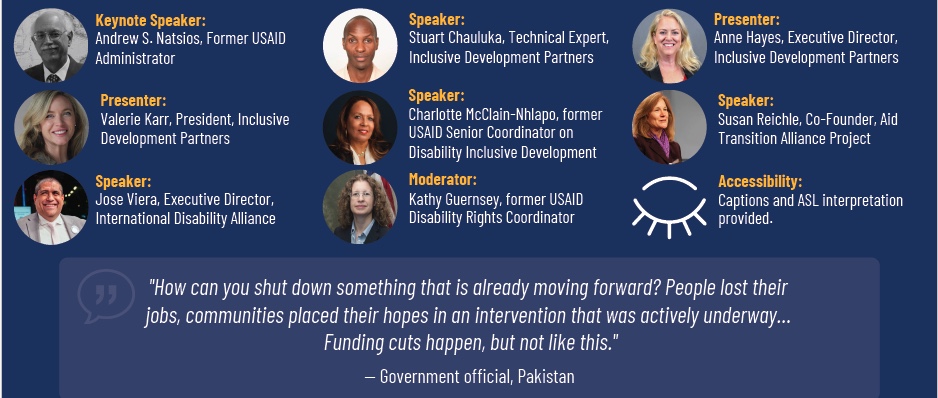
On June 24, 2026, Inclusive Development Partners hosted a webinar to release our new report, When Programs End Overnight: The Impact of the Dismantling of USAID on Persons with Disabilities. More than 500 people registered from across the world — disability rights advocates, researchers, OPD leaders, parents of children with disabilities, and development professionals from dozens of countries. The conversation that followed was one of the most honest, urgent, and necessary we have had in our combined decades of work in this field.
This blog shares what we found and why we believe this moment — as painful as it is — is also an opportunity to build something better.
How This Report Came to Be
IDP is a research and technical assistance organization with programs across 35 countries. Like many implementing organizations, we were left in a financial crisis when the U.S. government abruptly terminated its programming in early 2025, owing IDP hundreds of thousands of dollars for work already completed. We launched a GoFundMe campaign to cover payroll while awaiting those payments. More than 140 individuals donated — contributions as small as $15.
As we recovered financially, we recognized that the human cost of the USAID closure on persons with disabilities was going undocumented. No other donor was funding this research. Rather than allow that gap to persist, we directed the GoFundMe contributions toward this study, honoring the generosity of those donors by producing something lasting for the communities most affected.
The result is When Programs End Overnight — a mixed-methods study spanning eight countries: Bangladesh, El Salvador, Kenya, Liberia, Malawi, Nepal, Nigeria, and Pakistan. We collected data through a global survey of 82 projects across 80 implementing organizations, supplemented by key informant interviews and focus group discussions with government officials, OPD leaders, implementing partners, adults with disabilities, and parents and caregivers of children with disabilities.
What we found demands action.
Five Findings You Need to Know
1. USAID was working — and it was accelerating.
Across all eight countries, persons with disabilities were accessing life-changing services — education, employment, assistive devices, rehabilitation, life-saving medications — many for the very first time. Survey respondents estimated that the projects collectively aimed to reach approximately 349,000 beneficiaries with disabilities at the time of closure. As Co-Founder Valerie Karr noted during the webinar:
“Overnight we lost 20 active USAID programs across 17 countries.”
The 2024 “Nothing Without Us” Disability Policy had just launched, and implementing partners were restructuring their programs in response. One organization convened a senior leadership meeting before the policy’s formal adoption to begin planning for deeper inclusion across its entire portfolio.
This was not a system at its end. It was a system at its peak. Ambassador Andrew Natsios, former USAID Administrator and our keynote speaker, put it plainly: “The notion that the agency was corrupt or didn’t know what it was doing is utter nonsense.” And he was equally clear about what the closure represented:
“The sheer weight of it, and the number of groups that were getting assistance, all of that to be shut down overnight was extremely irresponsible, dangerous, and in my view, completely reckless. I think it was an abomination what happened to AID and the people suffering as a result.”
— Ambassador Andrew Natsios, Former USAID Administrator
2. The abrupt closure caused immediate and disproportionate harm.
When programs ended, they ended overnight. No transition plans. No advance notice. No handover.
Children with disabilities who had been attending school stopped going. Therapies vanished. Medications went out of stock. One health worker estimated that children with disabilities are three times more likely to experience malnutrition and death without access to support. In Nigeria, approximately 75% of students in an accelerated education program dropped out and returned to the streets.
The harm did not fall evenly. Among those employed by USAID and its implementing partners, 87% of persons with disabilities lost their jobs entirely, compared to 72% of those without disabilities. Stuart Chauluka, one of IDP’s technical experts and a person with a disability who lost his own position when USAID programs closed, described what that meant in practice:
“When I lost my job, I not just lost my paycheck, but I lost my professional community, and my autonomy that protected me from an inaccessible world. It was like just overnight switching off the lights.”
— Stuart Chauluka, Technical Expert, IDP
Across multiple countries in Africa, organizations also documented a sharp and sudden rise in families placing children with disabilities in institutions — not because their attitudes toward their children changed, but because the community-based supports that had made family care possible had disappeared overnight. Charlotte McClain-Nhlapo, former USAID Senior Coordinator on Disability Inclusive Development, named what this requires from donors:
“Communities want and deserve predictability, transparency, and continuity, and donors need to be accountable for the consequences of abrupt exits — not just for the activities that they fund.”
— Charlotte McClain-Nhlapo, Former USAID Senior Coordinator on Disability Inclusive Development
3. The closure triggered a collapse that experts warn could take decades to repair.
Trained specialists in inclusive education, disability-disaggregated data, assistive technology, and community-based rehabilitation have dispersed. Coordination mechanisms built over years have dissolved. OPDs have redirected their energy from rights-based advocacy toward organizational survival. In Pakistan, teacher training reverted to non-inclusive practices because the expertise that had supported the transition departed with the project. In Malawi, planning for a national disability database has been abandoned.
As one government official in Malawi put it: “We aren’t just standing still. We are moving backward.”
One implementing partner captured the long arc of what this means: “I feel like I will be spending the last few decades of my career just to get back to where we were right before USAID was dismantled.” Stuart Chauluka framed the stakes even more directly:
“When you dismantle the funding, you also dismantle the human being, you dismantle the human dignity, and the decades of slow, painful progress toward equality.”
— Stuart Chauluka, Technical Expert, IDP
4. No one has stepped in.
Eighty-three percent of survey respondents reported little to no gap-filling by other donors, other governments, or multilateral actors. In Central America, that figure was 96%. Charlotte McClain-Nhlapo quantified what disappeared:
“USAID’s Disability-Specific and Disability-Inclusive Programming totaled $140 million annually across USAID and the State Department. When that investment disappeared, 83% of respondents reported that little or no gap-filling by any other donor or government was in place.”
— Charlotte McClain-Nhlapo
Some bilateral and multilateral actors — including UNICEF and the World Bank — have continued to support disability-inclusive programming, and their efforts matter. But none has the scale, the disability-specific technical depth, or the funding levels that USAID provided. Jose Viera, Executive Director of the International Disability Alliance, was direct about why the private sector will not fill this void:
“It is an absolutely artificial fiction that private capital or private foundations will now step in and fill the gap left by USAID. We cannot expect that private capital will fulfill the obligations coming from states.”
— Jose Viera, Executive Director, International Disability Alliance
He also grounded the conversation in the reality facing most OPDs:
“Most of our organizations of Persons with Disabilities do survive with a budget of less than $5,000 a year. Imagine the many cases where that amount barely covers electricity costs.”
— Jose Viera
The April 2025 Global Disability Summit in Berlin produced over 800 new commitments to disability inclusion, but respondents across all eight study countries reported no evidence that these commitments have translated into programming on the ground. The gap is not temporary. It reflects an underlying structural reality: disability inclusion has been treated across the international development landscape as a niche concern rather than a cross-cutting priority. Closing it requires a fundamental reorientation — not a stopgap.
5. What was lost goes beyond services. It was hope.
Perhaps the hardest finding to quantify, and the one that stays with us most, is the loss of hope. Parents who had begun to believe their children could learn, find employment, and participate in community life described that belief as something that was taken from them.
“For a girl with a physical disability, in a rural area, every day is a challenge. So, initiatives like this actually made us hopeful that there are people thinking about us, our children. When the project ended, that made us lose that hope.”
— Mother of a child with a disability, Bangladesh
Research shows that hope is a documented predictor of parental well-being and long-term outcomes for children with disabilities. As we said during the webinar, its loss is not inconsequential — and it is very hard to rebuild. Every data point we collected is a real child, a real adult. A mother who was seen and supported, who now feels she doesn’t know how to keep her family going. This collapse is not abstract.
This Is Not DEI. This Is Law.
One of the most important points raised during the webinar is that disability inclusion is not a DEI program. It is a legal obligation.
Domestically, the Americans with Disabilities Act, the Rehabilitation Act, and the Workforce Innovation and Opportunity Act establish disability inclusion as a legal requirement. Internationally, the United States is a signatory to the UN Convention on the Rights of Persons with Disabilities, which explicitly requires that international cooperation be inclusive of and accessible to persons with disabilities. As Susan Reichle, Co-Founder of the Aid Transition Alliance, stated directly:
“The cuts — the bias pushed into the Disability Rights agenda through the Executive Orders — is just completely wrong-headed and illegal.”
— Susan Reichle, Co-Founder, Aid Transition Alliance
The current administration’s executive orders did not define what constitutes a DEI program. In that vacuum, disability inclusion was treated as DEI. Sign language interpretation was cut from budgets. Disaggregated data collection was eliminated. Programs specifically targeting persons with disabilities were terminated. Our report documents organizations actively concealing inclusive practices to protect their remaining awards — what one respondent described as “a don’t ask, don’t tell environment.”
When you try to conceal inclusion, it doesn’t save inclusion. It just means that people with disabilities lose access to services without anyone keeping a record of what was lost.
What Comes Next: A Call to Action
This report is not only a record of harm. It is a call to action. Susan Reichle put it simply during the webinar:
“In two words: Bear witness. Document. This is completely unacceptable, what has happened to the development community and the Disability Community.”
— Susan Reichle
For the U.S. Congress, we are asking for explicit clarification that disability-inclusive programming is legally distinct from DEI. We are calling for the Department of State to adopt the USAID 2024 “Nothing Without Us” Disability Policy, for dedicated disability funding to be restored through appropriations, for technical expert positions to be reinstated, and for oversight hearings on the documented impact of the closure on persons with disabilities.
For bilateral and multilateral donors, we are calling for the “Nothing Without Us” Policy, or an equivalent framework, to be adopted as a baseline standard; for mandatory disability-disaggregated data collection; and for a binding commitment to transition planning so that communities are never again left without warning when programs end. As Charlotte McClain-Nhlapo noted:
“The deepest harm came from unfinished cycles — training without certification, referrals without follow-ups, therapies that stop midstream. Donors need minimum continuity standards.”
— Charlotte McClain-Nhlapo
For private foundations, we are asking you to fund disability inclusion as a core priority — not a supplementary grant — and to fund OPDs directly, as standalone organizational investments rather than subgrantees of larger implementing organizations.
For implementing organizations, we are asking you to build inclusion in from the start, regardless of donor requirements, and to treat accessibility as a core budget line.
And for all of us: bear witness. Document what has happened. Keep this visible.
A Note on What This Moment Requires
Charlotte McClain-Nhlapo offered the framing that has stayed with us since the webinar:
“This is the moment to recognize the loss, but it is also an opportunity to pivot toward building a more resilient, more diversified, and locally-led financing architecture for Disability-Inclusive Development.”
— Charlotte McClain-Nhlapo
We believe that. The model that existed before was not perfect. OPDs were too often implementers rather than co-designers. Too many programs were funded by a single donor. Too few were embedded in government systems deeply enough to survive a funding change. This collapse exposed those vulnerabilities — and rebuilding well means addressing them.
The evidence in this report shows clearly that disability-inclusive development works. Children learned. Adults found employment in systems that had always excluded them. Mothers felt seen and supported, many for the first time. As Ambassador Natsios told us: “We need hard evidence that you have produced in this report, so thank you for doing it.” We hope that evidence now serves the communities who made it possible — and that it moves everyone reading this to act.
The full report, When Programs End Overnight: The Impact of the Dismantling of USAID on Persons with Disabilities, is available at https://www.inclusivedevpartners.com/usaid-research/